
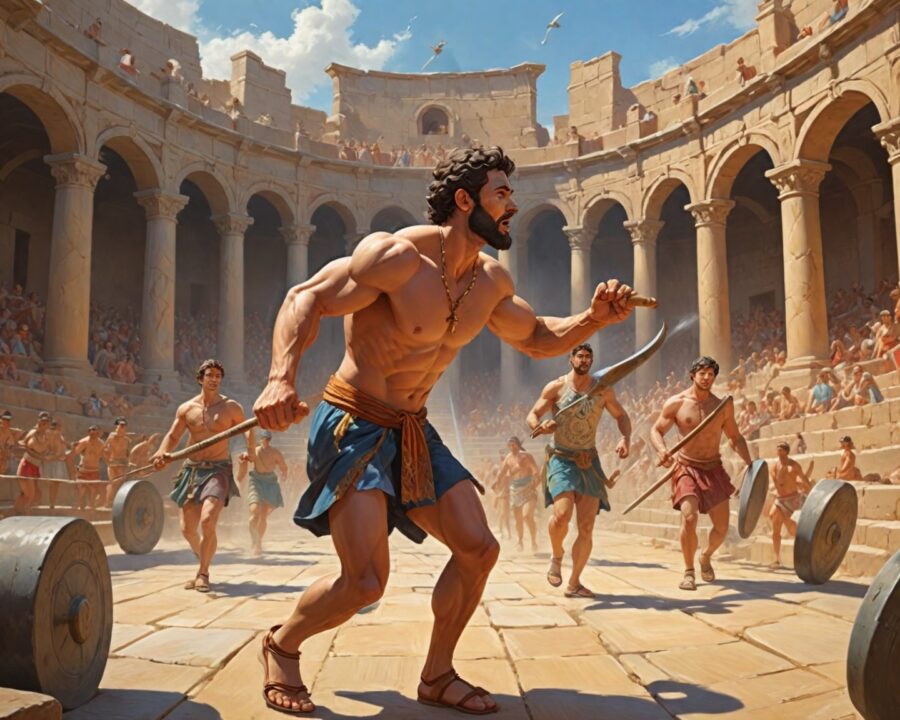
Introduction to Ancient Sports and Their Cultural Significance
Ancient sports have played a pivotal role in shaping the cultures and societies from which they emerged, weaving themselves into the very fabric of everyday life in civilizations that date back thousands of years. These early forms of athletic competitions were far more than just games; they were often intertwined with religious rites, community celebrations, and served as embodiments of physical prowess and competitive spirit. The birth of many ancient sports can be traced back to the desire to display not only physical strength and dexterity but also social status and political power.
As we delve into the history of these ancient pastimes, it becomes evident that many modern sports owe their origins to these millennia-old traditions. From the stark rigor of Greek athletics to the pageantry of Roman spectacles, ancient sports have laid the groundwork for contemporary competitions, influencing how we perceive and participate in athletics today. Understanding the origins and evolution of these activities provides insight into human ingenuity and the enduring spirit of competition.
The Origins of the Ancient Olympic Games
The ancient Olympic Games stand as one of the earliest and most renowned athletic festivals. Originating in Olympia, Greece, these games are believed to have started in 776 BC, although they may have existed in some form earlier. The Olympics were primarily a religious event held in honor of Zeus, the supreme Greek deity, and took place every four years for over a millennium.
Participation in the games was originally limited to male Greeks, emphasizing activities such as running, wrestling, and the pentathlon, which included discus and javelin throws, a race, long jump, and wrestling. Victorious athletes were celebrated as heroes, often immortalized in statues and songs, and their achievements were seen as the pinnacle of human excellence.
The Olympic Games grew to symbolize unity among the Greek city-states, which despite being often at war with each other, called a truce during the games to compete in peace. This ideology of bringing people together through sports continues to resonate in the modern incarnation of the Olympics.
Popular Sports in Ancient Greece, Rome, and Egypt
In ancient Greece, athletic prowess was highly esteemed, leading to the development of various sports, including the pankration, a no-holds-barred combat sport. Track and field events, boxing, and the aforementioned pentathlon were also popular.
Rome introduced a more extravagant form of competition, involving gladiatorial games that captivated the masses. Public spectacles often included chariot races at the Circus Maximus and various feats of strength and endurance exhibited in amphitheaters such as the Colosseum.
Contrastingly, ancient Egyptian sports were integrated into daily life and ranged from competitive swimming and rowing to more playful activities like fishing and hunting. Documentations found on tomb walls suggest a culture deeply engaged in physical activities, considered essential training for warriors.
The Role of Sports in Ancient Societies and Rituals
Sports in ancient cultures were closely intertwined with religious and ceremonial practices. For the Greeks, competing in athletic events was seen as an offering to the gods, particularly Zeus, enhancing their personal honor alongside communal ties. The games provided a stimulus for economic and political activities, creating a unique amalgam of sport and society.
In Rome, sporting events served as tools for political propaganda, where emperors showcased their magnanimity by providing free spectacles, thus gaining public favor. The games became a reflection of power, wealth, and societal hierarchy.
Egyptians viewed sports as part of their religious doctrine, associating prowess in physical feats with divine favor. Pharaohs often partook in hunting and archery competitions, seen as demonstrations of their strength and their role as protectors and providers for their people.
Famous Athletes and Competitions from Ancient History
Figures like Milo of Croton, an ancient wrestler with a long series of victories, became legendary not only for their physical achievements but also for their larger-than-life stories, which often intertwined with myth. Milo is said to have carried a bull on his shoulders and to have been a companion of Pythagoras, the famous mathematician.
Chariot racing in Rome had its icons, with famous charioteers like Scorpus who drove his way to fame and acquired immense wealth. These figures were equivalent to modern sports heroes, celebrated and admired for their skill and daring.
In Egypt, Queen Hatshepsut is reputed to have excelled in hunting and archery, activities that highlighted her leadership and influence, thus integrating athletic prowess with political excellence.
Comparison of Ancient and Modern Sports Practices
Comparing ancient and modern sports brings attention to both differences and continuities. Ancient sports often emphasized raw strength and endurance, frequently held in arenas that doubled as places of worship or community congregation. Modern sports, while similarly competitive, place greater emphasis on precision, skill, and strategy, often within internationally recognized structures and rules.
Moreover, the advent of technology and sophisticated training methods has transformed sports into highly specialized disciplines, unlike the mixed and varied athletic traditions of the past. However, the basic principles of competition, discipline, and the pursuit of excellence remain steadfastly similar across the ages.
| Ancient Sports | Modern Sports | Key Similarities |
|---|---|---|
| Primarily focused on raw physical prowess | Highly specialized technical skills | Both emphasize competition, discipline, and athletic excellence. |
| Integrated with religious and social events | Defined by global tournaments and leagues | Serve as social activities that encourage unity and identity. |
| Localized and culturally specific | Global and culturally diverse | Inspire participants and audiences, transcending cultural and geographical barriers. |
The Influence of Ancient Sports on Modern-Day Athletics
The groundwork laid by ancient sports has had lasting impacts on contemporary athletics. Not only do we see tangible legacies in sports like wrestling and track events, but the very notion of celebrating athletic competition as a fundamental element of human endeavor stems from ancient practices.
The Olympic Games, revived in 1896, directly draw from their ancient counterpart’s ideology of fostering international unity through friendly competition. Phrases such as “Citius, Altius, Fortius” (Faster, Higher, Stronger) echo principles witnessed in ancient Greek stadiums.
Sportsmanship and the cultural significance of athletes as role models have also been inherited from antiquity, providing ethical frameworks and standards by which modern sports are judged.
Common Questions About Ancient Sports and Their Rules
What were the major sports in ancient Greece?
The major sports in ancient Greece included running events, wrestling, the pentathlon (comprised of five different events), boxing, pankration, and equestrian events like chariot racing. These were chiefly featured in the Olympic Games.
How did ancient athletes prepare for competitions?
Ancient athletes usually prepared by following rigorous training routines, which included specialized exercises and dietary plans tailored to build strength and endurance. They trained in gymnasiums, which were centers for athletic training and education.
Were women allowed to compete in ancient sports?
In ancient Greece, women were generally excluded from athletic competitions; however, they could participate in their own set of games, like the Heraean Games. Conversely, in some Egyptian sports, women participated more freely and were even depicted in athletic scenes.
How were ancient sports competitions organized?
Ancient sports competitions were typically organized as part of larger religious and public festivals. They followed rituals such as opening ceremonies, sacrifices to the gods, and awarding prizes, which enhanced the spiritual and social aspects of the events.
What were some of the dangers associated with ancient sports?
Many ancient sports were dangerous due to the lack of protective gear and the competitive nature of events like chariot racing and pankration, which had few rules. Injuries and fatalities were not uncommon, emphasized as tests of courage and endurance.
Preservation and Rediscovery of Ancient Sports Artifacts
Archaeology and the study of historical documents have allowed for the preservation and rediscovery of ancient sports artifacts. Items such as terracotta statuettes, frescoes, and inscriptions provide insight into the equipment used, the nature of the competitions, and the societal role of athletes.
Museums around the world house many of these artifacts, offering a glimpse into the opulent history of sports. The excavation of sites like Olympia has been critical in shedding light on the ancient Olympic Games’ significance and mechanics, sparking continued interest and research.
How to Explore Ancient Sports Through Museums and Historical Sites
Experiencing the legacy of ancient sports can be an enriching endeavor that blends travel, history, and culture. Notable sites like the ancient city of Olympia in Greece, the Colosseum in Rome, and Egyptian tombs in Luxor are popular destinations for those interested in antiquity’s athletic past.
Museums such as The British Museum in London, The Louvre in Paris, and The National Archaeological Museum in Athens display extensive collections that vividly depict the athletic traditions from different ancient cultures, offering educational tours and exhibitions that bring these timeless practices to life.
Recap
Ancient sports were integral to the religious, cultural, and social fabric of civilizations across the Mediterranean and Near East. Origins of organized sports can be traced back to Greece with the Olympic Games, while sports in Egypt and Rome thrived as part of daily and political life. The influence of these early competitions resonates in modern sporting practices, showcasing continuity in human athletic expression across millennia. Understanding ancient sports offers vital perspectives on how societal values and cultural traditions have shaped contemporary athletics.