

History often hides brilliant sparks of genius beneath layers of dust. Many thinkers throughout the ages conceptualized complex devices long before society possessed the infrastructure to build them. These forgotten inventions that were far ahead of their time prove that human creativity has always pushed boundaries.
Modern science frequently catches up to concepts drafted centuries ago. By exploring these early blueprints, we gain a unique perspective on the cyclical nature of progress. It is truly fascinating to see how yesterday's dreams become today's reality.
Join us as we embark on a journey through history. We will uncover how visionary minds paved the way for the technology we rely on today. This exploration highlights the enduring power of human curiosity and the drive to solve complex problems.
Key Takeaways
- Ancient civilizations often conceptualized technology centuries before its practical application.
- Human ingenuity follows a cyclical pattern of discovery and rediscovery.
- Many modern devices have roots in early, overlooked mechanical designs.
- Historical breakthroughs provide essential context for current scientific advancements.
- Studying past failures and successes helps us understand the evolution of modern engineering.
The Context of Lost Innovation
Why do some groundbreaking historical innovations fade into obscurity? Often, it's because they were born in the wrong time. Inventors faced eras without the right materials, support, or demand.
Why History Overlooks Revolutionary Creations
The journey to success for new tech is rarely easy. Overlooked revolutionary creations often lacked the support they needed. Without a ready market or infrastructure, even the most brilliant ideas were forgotten.
Several factors led to these inventions being forgotten:
- Lack of Scalability: The tech worked in labs but couldn't be made on a large scale.
- Economic Barriers: Old industries saw new tech as a threat to their profits.
- Societal Readiness: People and governments weren't ready to use the new tech in everyday life.
The Impact of Technological Amnesia on Modern Progress
Technological amnesia happens when we forget how to build or improve past inventions. This makes us start over, wasting time and resources. When we forget the past, we lose valuable knowledge.
This forgetting has big effects on our progress today. By ignoring these overlooked revolutionary creations, we miss out on new solutions. Learning from history helps us avoid mistakes and speed up our discoveries.
Forgotten inventions that were far ahead of their time
Some of the most impressive creations were developed centuries before their time. These forgotten inventions that were far ahead of their time show us that progress isn't always linear. They highlight the mechanical genius of our ancestors.

The Antikythera Mechanism: The World's First Analog Computer
Found in a shipwreck off Greece, the Antikythera Mechanism is a mystery. It had bronze gears that worked like an early analog computer. It could track stars and predict eclipses and Olympic Games years ahead.
The engineering needed to make it is amazing for the ancient world. It shows that ancient people knew more about gears than we thought. This device is a key example of futuristic inventions from the past that were too advanced for their time.
Hero of Alexandria's Steam Engine: A Missed Industrial Revolution
In the first century, Hero of Alexandria created the aeolipile. It was a steam engine that spun a metal sphere with steam. But, it was seen as a novelty or a temple toy rather than a tool for industry.
The society back then didn't see the need to use machines over humans or animals. So, the steam engine was just a curiosity for centuries. It shows that even great ideas need the right time and place to change the world.
Ancient Engineering Marvels
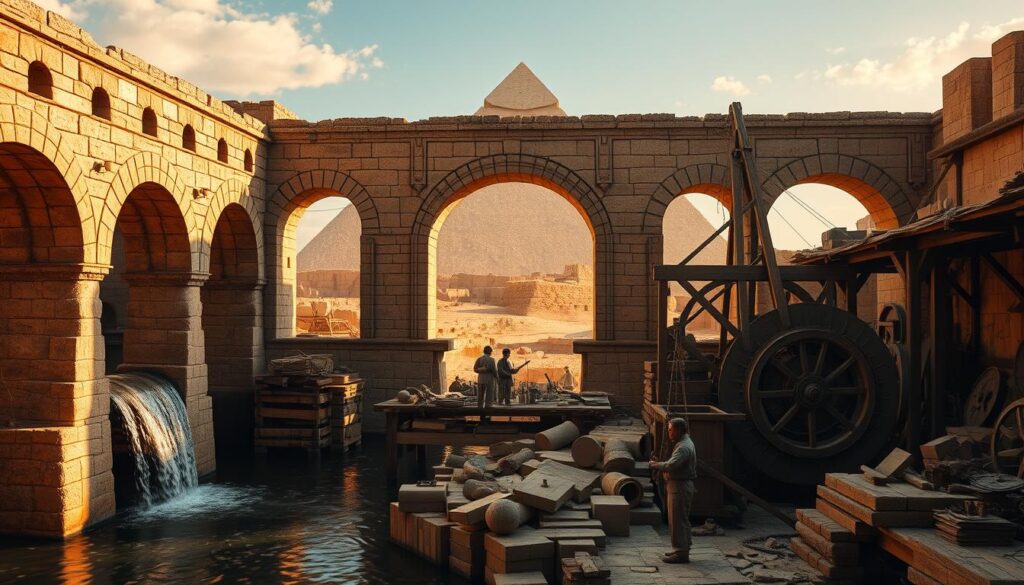
The history of human ingenuity is filled with groundbreaking historical innovations that still amaze us today. We often think of modern tech as the pinnacle of innovation. But ancient artisans were already working with complex chemical processes. They used natural resources in ways that show a deep understanding of molecular science.
Damascus Steel: The Mystery of Nanotechnology in Medieval Blades
Damascus steel blades were famous for their sharp edges and unique patterns. For a long time, Western blacksmiths couldn't figure out their secret. Now, we know they contained carbon nanotubes, making them some of the most advanced creations in history.
"The steel was so hard that it could cut through a silk scarf falling through the air, yet it remained flexible enough to never shatter in battle."
Roman Concrete: The Secret to Millennia-Long Durability
Roman concrete, or opus caementicium, has lasted over two thousand years, often beating modern buildings. Its secret is volcanic ash, which reacts with seawater to create rare minerals. These minerals strengthen the material, allowing it to heal cracks on its own.
The table below shows why these ancient materials lasted for centuries:
| Material | Key Component | Primary Benefit |
|---|---|---|
| Damascus Steel | Carbon Nanotubes | Extreme Sharpness |
| Roman Concrete | Volcanic Ash | Self-Healing Ability |
| Modern Steel | Iron Alloys | Mass Production |
| Modern Concrete | Portland Cement | Rapid Setting |
By looking at these ancient materials, we see the sophisticated engineering capabilities of the past. They show us that ancient builders were true pioneers in material science, not just lucky.
Industrial Era Concepts That Failed to Launch
The late 19th century was a time of bold ideas. Inventors created futuristic inventions from the past that aimed to change our lives. But, not all of these ideas made it in the market.
Many historical technological advancements were held back by money issues and big industries. Some ideas were good but didn't get the support they needed. This shows how society picks its path.
Nikola Tesla's Wireless Power Transmission Vision
Nikola Tesla wanted to send energy through the air without wires. His Wardenclyffe Tower was meant to give free electricity worldwide. It was a bold futuristic invention from the past.
But, it hit many roadblocks. Investors were unsure about its profitability. So, the dream of wireless power was dropped, leaving only plans and dreams.
The Electric Car of the 1890s: Why Gasoline Won the Race
Before gasoline cars, electric vehicles were popular in cities. They were quiet, easy to use, and didn't smell bad. These historical technological advancements seemed set to lead the transport world.
But, things changed:
- Range limitations: Early batteries were heavy and needed frequent charging, limiting travel.
- Infrastructure: Gasoline was easy to find, but electric charging stations were rare.
- Economic influence: The discovery of oil made gasoline very cheap and accessible.
In the end, gasoline's ease of use and long travel distances won out. The electric car was forgotten for nearly a century. It shows how market forces decide on new tech.
The Role of Patent Suppression and Economic Barriers
Innovation often faces a silent enemy hidden behind boardroom doors and legal filings. While we celebrate progress, many overlooked revolutionary creations never reached the public eye. This is due to calculated interference. This darker side of history shows how established industries prioritize their own survival over society's advancement.
Corporate Interests and the Stifling of Disruptive Tech
Large corporations often buy patents to keep them from competitors. By doing this, they can shelve the invention indefinitely. This protects their existing revenue streams from being made obsolete by newer, more efficient alternatives.
When a new invention threatens a dominant business model, the pressure to suppress it grows. Companies may use legal teams to tie up inventors in endless litigation. Or they might buy out the competition to silence the threat. This ensures the status quo remains unchallenged for as long as possible.
Economic Factors That Buried Pioneering Inventions
Beyond corporate maneuvering, harsh economic realities often doom promising ideas. Many neglected pioneering inventions required massive infrastructure changes that were too expensive for the era. If a new technology couldn't easily integrate into existing systems, it was often deemed financially unviable by investors.
Market timing also plays a critical role in the success or failure of a new concept. Even if an invention is technically superior, it may fail if the public is not ready to adopt it. Or if the cost of production is too high. These economic barriers have historically acted as a filter. They allow only the most profitable—rather than the most innovative—ideas to thrive.
Modern Perspectives on Historical Tech
Researchers are now uncovering secrets of old mechanical marvels. They use modern science to understand ahead-of-its-time creations. This helps link ancient genius with today's engineering.
How Researchers Are Reconstructing Lost Blueprints
Today, historians and engineers use new tech to see inside old devices. High-resolution X-ray tomography lets them look at corroded metal. They find hidden gear systems that were lost for centuries.
Also, 3D modeling software helps create digital versions of these devices. By testing these models, researchers learn how they worked. This turns old, broken pieces into working blueprints.
Lessons Learned from Neglected Pioneering Inventions
Looking at neglected pioneering inventions teaches us a lot. Many failed not because they were bad, but because of timing or lack of support. Learning from these past challenges helps today's developers avoid mistakes.
By studying why these ideas didn't catch on, engineers spot patterns. This teaches them to think more holistically about new tech. It shows that success often depends on more than just the tech itself.
Conclusion
Human progress depends on looking back to move forward. Many modern breakthroughs are improvements on old ideas. These historical advancements guide future innovators in solving big problems.
Exploring the past shows that genius is timeless. Great ideas often need the right time or tools to succeed. By studying these old ideas, we appreciate human creativity's lasting power.
We should keep exploring history's archives. Each find gives us a fresh view on how we shape our world. Share these tales to keep curiosity alive and growing.