
Before digital wallets, people found smart ways to trade. They used forgotten financial systems from ancient civilizations to manage wealth. Items like shells or stones made sure every deal felt fair and safe for all.
Looking into historical money systems shows the roots of today’s economy. Many modern banking tools come from these early ideas. It’s amazing to see how ancient societies shaped our use of coins and credit today.
These early methods were more than just bartering. They were complex agreements that helped build big cities and empires. By studying them, we see how much humans value order in their lives.
Key Takeaways
- Discover the fascinating origins of modern economic structures.
- Understand how trust and security shaped early trade.
- Identify the unique natural materials used as early money.
- Learn how past societies influenced today’s banking habits.
- Explore the cultural value of various exchange methods.
- See why these old legacies still matter in countries like Brazil.
Uncovering Forgotten Financial Systems from Ancient Civilizations
Exploring the forgotten financial systems of ancient civilizations gives us new insights. These old practices have greatly influenced our modern economy. They are hidden in history but still shape our financial world today.
The Shift in Modern Economic Perspectives
Our views on economics have changed a lot thanks to ancient financial systems. For a long time, studying ancient economies was seen as less important than newer theories.
But, recent research shows that ancient financial practices were complex and sophisticated. The history of ancient economies is not just old news. It’s the base of our modern economic systems.
“The economic history of ancient civilizations is not just a relic of the past; it is a foundation upon which modern economic systems have been built.”
Learning about ancient economic practices has made us see how financial systems grow. For example, the use of commodity money in the past is similar to today’s commodity-based currencies.
Why Ancient Monetary Records Matter Today
Ancient monetary records give us a peek into the past. They show how ancient civilizations handled money, debts, and savings. These records are key to understanding the growth of financial tools and monetary policies.
| Civilization | Monetary System | Key Features |
|---|---|---|
| Mesopotamia | Shekel-based economy | Use of barley and silver for transactions |
| Ancient Greece | Drachma-based economy | Introduction of coinage |
| Rome | Denarius-based economy | Standardization of currency |
Knowing about economic structures in antiquity helps us today. It teaches us about the stability and ups and downs of different economic systems.
The Evolution of Ancient Trade and Exchange Methods
The way ancient societies traded and exchanged goods evolved over time. As communities grew, their economic systems got more complex. This led to the need for new ways to trade and exchange.
Barter Systems and the Birth of Commodity Money
In the beginning, barter systems were common. People traded goods and services directly, without using money. But, barter had its limits, which led to the creation of commodity money.
Commodity money, like cattle, grains, and metals, made trade easier. It provided a standard way to exchange goods. This was key for the growth of early economies.
The Role of Temple Economies in Mesopotamia
Temple economies in Mesopotamia were important for early finance. They were not just places of worship but also centers of economic activity.
Centralized Storage and Credit Systems
Temples acted as centralized storage facilities for goods like grains. This helped create credit systems. Merchants could store their goods and get receipts, which were like money or credit.
This setup made complex transactions possible. It also helped build the foundation for today’s banking systems.
Some key aspects of ancient trade and exchange include:
- Standardization: Standard weights and measures for goods.
- Commodity Money: Items like metals and grains used as money.
- Credit Systems: Early forms of credit for more complex transactions.
The temple economies of Mesopotamia were crucial for modern banking. Their storage and credit systems supported early financial transactions. These were advanced for their time.
Financial Customs in Ancient Cultures and Their Global Reach
Ancient civilizations had their own financial customs that still shape global finance today. These customs were influenced by their culture, society, and economy. They have had a lasting impact on how we handle money now.
The exchange of goods and ideas across ancient trade routes started international finance. The Silk Road was a key trade network. It connected the East and West through a complex network of routes.
The Silk Road and Early International Finance
The Silk Road played a big role in early international finance. It wasn’t just for exchanging goods like silk and spices. It also helped spread financial practices and instruments.
Merchants used letters of credit and bills of exchange on the Silk Road. These tools helped reduce risks when trading over long distances. They made it easier to move goods and money safely.
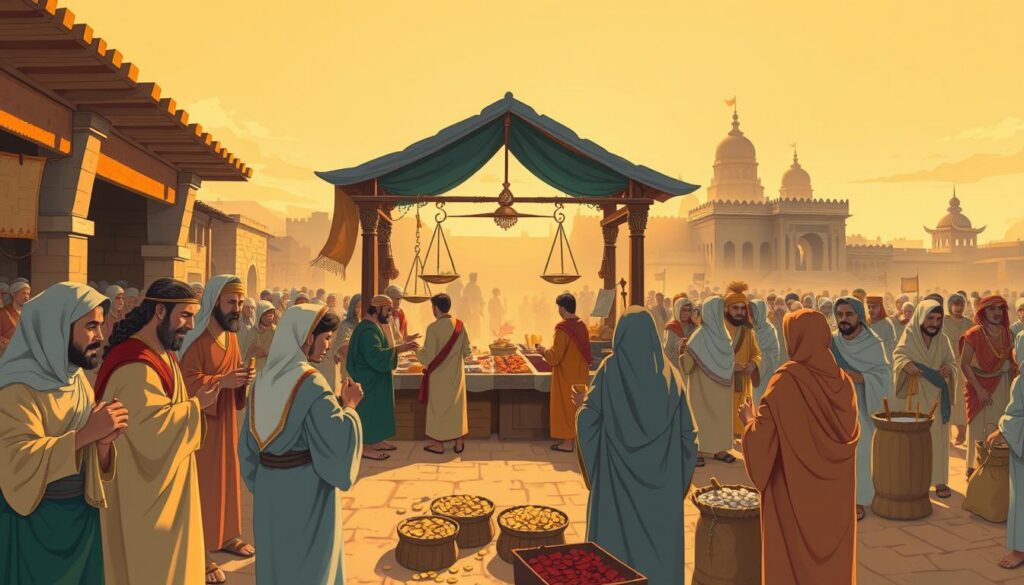
As trade grew on the Silk Road, financial centers started to form. Cities like Samarkand and Xi’an became key for international trade and finance. They helped lay the groundwork for modern banking systems.
How Ancient Economic Structures Influenced Modern Banking
Ancient economic systems, like temple economies, helped create modern banking. The use of deposits, loans, and interest rates in ancient times is similar to today’s banking. This shows how ancient practices paved the way for modern banking.
“The development of banking is closely tied to the evolution of financial instruments and practices in ancient civilizations.”
The Legacy of Interest and Debt Management
The idea of interest and managing debt comes from ancient times. Charging interest on loans was common in many ancient societies. The Sumerians, for example, recorded loans and interest rates on clay tablets.
| Civilization | Financial Practice | Modern Equivalent |
|---|---|---|
| Mesopotamia | Temple economies, clay tablets for loans | Modern banking, digital records |
| Ancient Greece | Trapezai (banking institutions) | Commercial banks |
| Roman Empire | Argentarii (money changers and lenders) | Currency exchange, personal loans |
Today’s banking practices owe a lot to ancient customs. From interest rates to debt management, these ancient practices are still with us. Understanding these roots helps us see how financial systems have evolved.
Recent Archaeological Discoveries Reshaping Financial History
Excavations around the world are uncovering new details about our ancestors’ financial practices. These discoveries are not only interesting but also offer valuable insights into ancient economies. They are changing how we see financial history, showing complex systems we didn’t know about before.
New Evidence from Excavations in the Mediterranean
The Mediterranean has seen a lot of archaeological work, revealing a lot about ancient finance. Recent finds in Greece and Turkey show advanced monetary systems thousands of years old. These discoveries challenge old ideas about ancient economies, showing they were more complex than thought.
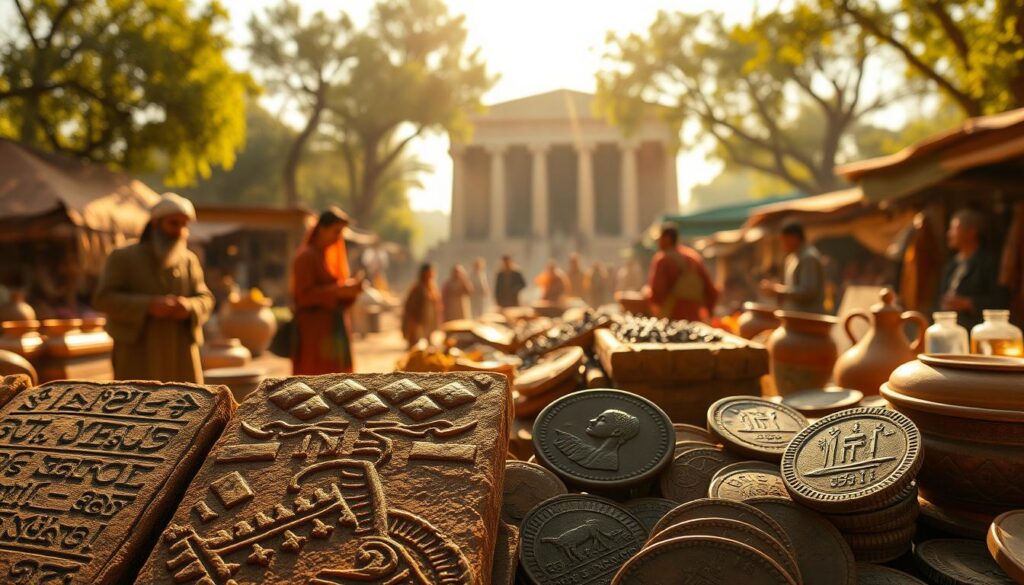
Analyzing Ancient Ledger Tablets and Clay Records
Old ledger tablets and clay records are key to understanding ancient finance. They detail transactions like trade and taxes. By studying these, historians and archaeologists can piece together ancient financial systems.
Looking at these records takes a team effort. Experts from history, archaeology, and economics work together. This teamwork helps us grasp how ancient societies managed money and how it shaped today’s finance.
What These Findings Reveal About Wealth Distribution
Studying these records also sheds light on ancient wealth distribution. Researchers can spot patterns in who had wealth. This is key to understanding ancient societies’ social and economic structures.
Some studies show wealth was mainly in a few hands, while others suggest it was more spread out. These findings on ancient wealth help us talk about today’s economic inequality and different systems.
Conclusion
Looking into forgotten financial systems from ancient times helps us understand modern finance better. It shows how old economic ways still shape today’s money systems.
Early societies used barter and commodity money. Later, the Silk Road helped create modern banking and global finance. New finds in archaeology have changed how we see financial history, showing the importance of old records.
Learning from these ancient systems helps us appreciate today’s finance more. It also helps us make today’s systems better. This knowledge gives us a deeper view of the global economy.