

For years, many thought the Amazon rainforest was untouched. But now, researchers know this isn't true. A major paradigm shift is changing how we see Brazil's past.
Modern tools are uncovering the stories hidden in the rainforest. Scientists use advanced technology to map the ground. They find evidence of sophisticated societies that lived long ago.
This new evidence challenges old ideas about South America's growth. It makes us see the rainforest in a new light. We're learning more about the people who lived there. Let's dive into these exciting discoveries that change our view of history.
Key Takeaways
- New archaeological evidence suggests the Amazon was home to complex, large-scale societies.
- Modern technology like LiDAR is essential for seeing through the dense rainforest canopy.
- The old idea of a pristine, untouched wilderness is being replaced by evidence of human management.
- These discoveries challenge traditional academic views on South American civilization.
- Ongoing research in Brazil continues to reveal how past cultures shaped the environment.
The Current State of Archaeological Discovery in Brazil
A new era of discovery is unfolding in Brazil, revealing layers of history once thought lost. Researchers are now exploring beyond the surface to uncover complex societies that existed before European contact. This new approach is helping to recover lost wisdom and give us a clearer view of ancient life.
Recent breakthroughs in the Amazon basin
The Amazon basin was once seen as untouched wilderness. But recent discoveries show it was home to large-scale earthworks, managed forests, and advanced urban planning. Scientists are now solving historical mysteries by finding evidence of dense populations that once thrived in the rainforest.
Collaborative efforts between local researchers and international experts
Success in these projects comes from teamwork between local Brazilian teams and global researchers. By mixing local knowledge with advanced tools, they ensure findings are accurate and respectful. This inclusive approach is key to preserving the archaeological record.
The table below shows how new methods are changing how we study these sites compared to old ways.
| Methodology | Traditional Approach | Modern Approach |
|---|---|---|
| Data Collection | Manual excavation | Remote sensing |
| Site Mapping | Hand-drawn sketches | LiDAR technology |
| Collaboration | Isolated research | Global partnerships |
| Focus | Artifact recovery | Landscape analysis |
As teams work together, they fill gaps in our understanding of the past. Their ongoing work ensures that lost wisdom is not just found but also protected for the future. Through these collaborative breakthroughs, we are getting closer to solving the historical mysteries of the region.
Ancient knowledge lost through history: Unearthing the Amazonian Geoglyphs
Deep in the Amazon, ancient knowledge lost through history is now being uncovered. In Acre, archaeologists have found complex patterns that were thought to be beyond early societies' abilities. These earthworks are changing our view of ancient civilizations in South America.
The discovery of geometric earthworks in Acre
In Acre, the geoglyphs include large ditches and embankments in shapes like squares and circles. These massive earthworks cover huge areas, sometimes hundreds of meters wide. There are dozens of these sites, showing that more people lived there than we thought.
Understanding the purpose behind these massive structures
Experts are still figuring out why these earthworks were built. But they think they were not homes. Instead, they were central hubs for communities. They likely hosted ceremonies, social meetings, and helped protect resources.
- Ceremonial gatherings and religious rituals.
- Social meetings to strengthen community bonds.
- Defensive perimeters to protect local resources.
Evidence of complex social organization
The size of these projects shows that these societies were well-organized. Creating them needed a lot of planning and engineering skills. This shows that these ancient civilizations could change their environment to meet their needs.
The discovery of these geoglyphs forces us to rethink the history of human settlement in the Amazon basin.
The role of geoglyphs in ancient land management
These structures were more than social hubs. They helped people manage the forest. They marked areas for farming and hunting, showing how these societies lived in harmony with nature. This knowledge was passed down, helping future generations understand their connection to the land.
Advanced Agricultural Techniques of Pre-Columbian Societies
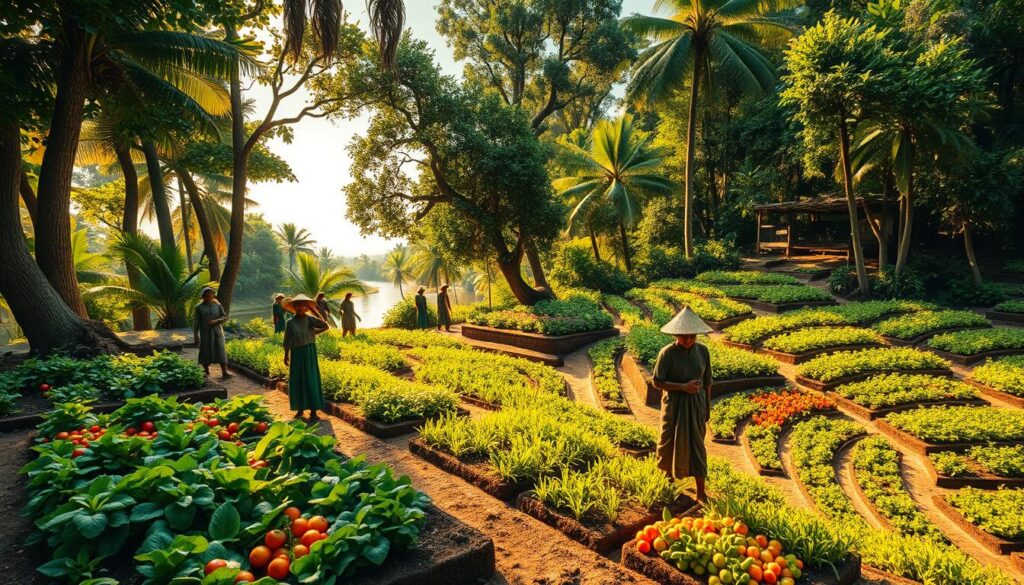
The secret to supporting huge populations in the Amazon is the forgotten wisdom of its first people. Many thought the rainforest couldn't handle big farms, but ancient societies proved them wrong. They used advanced methods that are now helping us today.
Terra Preta: The secret of fertile Amazonian soil
Terra Preta de Índio, or Amazonian Dark Earth, is a key find. It's a super-rich soil, unlike the acidic and poor soil found naturally in the Amazon.
Ancient farmers made this soil by mixing charcoal, bone, and organic waste. This durable soil structure let them farm for centuries without harming the land.
Sustainable farming practices that supported large populations
These early people didn't just survive; they thrived. They worked with nature, creating systems that supported dense populations without harming the forest.
- Nutrient cycling: They kept the soil healthy by adding organic waste.
- Permanent settlements: Stable food sources helped villages grow big and stay.
- Resource management: They planned carefully to keep the environment balanced for the long term.
Water management systems in tropical environments
Managing water in the tropics is tricky to avoid erosion and floods. Pre-Columbian societies built complex canals and raised fields to control water.
These systems made sure crops got enough water when it was dry and didn't get too wet when it rained a lot. Their forgotten wisdom in water engineering is still amazing today.
Crop diversification and forest gardening
These societies didn't rely on one crop. They turned parts of the forest into gardens that looked like the natural forest.
They planted many fruit trees, medicinal plants, and staples like manioc. This historical secret shows they were experts in using land sustainably, teaching us valuable lessons for the future.
Decoding Lost Scripts and Symbolic Communication
In the remote corners of Brazil, mysterious carvings reveal lost wisdom. These symbols show the cultural and spiritual lives of early people. They lived long before we started keeping records.
Researchers see these markings as a key part of human history. By studying these sites, experts aim to connect the past with today.

Analyzing petroglyphs found in remote regions
Petroglyphs are like a visual language on stone. They often show local animals, sky events, and rituals. These were important to the community.
Every stroke tells a story of survival and belief. Scholars document these images to save the heritage in deep jungles.
The challenge of interpreting non-alphabetic records
Decoding these carvings is hard because they don't use a standard alphabet. Without a written grammar, experts must use a multidisciplinary approach to understand the meaning.
"The past is a foreign country; they do things differently there."
This task needs patience and teamwork. Archaeologists, linguists, and local communities work together. They aim to understand the context of each symbol.
Comparing Brazilian findings with other ancient civilizations
When scholars study these findings, they compare them to other ancient civilizations worldwide. This comparison helps spot common patterns in how humans document their lives.
Whether in the Amazon or the Nile Valley, societies all want to leave a mark. By understanding these connections, we get a clearer view of how ancient civilizations evolved through their own lost wisdom.
Modern Technology Accelerating Historical Revelations
Digital advancements are changing how we uncover old stories. Now, researchers use high-tech tools to explore places that were once unreachable. These tools help us see the past more clearly than ever before.
The role of LiDAR in mapping hidden landscapes
LiDAR, or Light Detection and Ranging, has changed how scientists see the forest floor. It sends laser pulses from planes to create detailed 3D maps. This technology strips away dense vegetation to show structures hidden for centuries.
This tech is key for finding earthworks and old paths that are hard to see. It helps map large areas fast, uncovering forgotten wisdom.
Satellite imagery and remote sensing breakthroughs
Satellite images give a bird's-eye view of ancient settlements. Remote sensing lets teams spot changes in soil and plants from space. These signs often show where people lived long ago.
By studying these signs, scientists can figure out how ancient societies planned their lands. This comprehensive approach makes finding mysterious historical knowledge more efficient.
How digital modeling preserves fragile artifacts
When a site is found, digital modeling captures every detail for study. High-resolution scans make virtual copies of fragile items. This way, delicate artifacts are documented without harm.
These digital collections let scholars around the world work together. By keeping forgotten wisdom and mysterious historical knowledge digital, we protect these cultures for future generations.
The Impact of New Findings on Global Historical Narratives
The idea that the Amazon was untouched is being challenged by new evidence. Researchers are finding historical secrets that show humans shaped the Amazon for thousands of years. This changes how we see the rise of early civilizations.
Challenging the myth of the pristine wilderness
For years, many thought the rainforest was untouched. But archaeological data now shows indigenous people managed these ecosystems. They used smart methods to make the forest fertile and diverse.
This discovery solves many historical mysteries about how people lived in the tropics. It shows the forest was a resource, not just a backdrop. This changes how we view human impact and care for the environment.
Revising the timeline of human settlement in South America
New evidence shows humans were in South America earlier than thought. By studying ancient earthworks and pottery, scientists are rewriting history. This revising of the timeline reveals the depth and complexity of indigenous history.
These historical secrets prove complex societies existed before Europeans arrived. Knowing this timeline is key to honoring the first people of this land. It gives us a clearer picture of human migration and cultural growth.
Why these discoveries matter for modern environmental science
These findings are more than just history; they guide us to the future. By learning from ancient cultures, scientists can find sustainable practices. These ancient models are crucial for tackling today's climate issues.
| Concept | Traditional View | Modern Evidence |
|---|---|---|
| Amazon Landscape | Pristine Wilderness | Managed Ecosystem |
| Human Impact | Minimal/None | Active Stewardship |
| Settlement Age | Recent Arrival | Deep Ancient Roots |
These historical mysteries show humans can live sustainably in complex ecosystems. Using these ancient lessons could help us protect our world for the future. The past is a guide for our environmental journey today.
Conclusion
Every new find in the Amazon changes how we see the ancient world. These discoveries show that complex societies existed in the rainforest before we knew about them. By learning from this, we understand human strength and creativity better.
Uncovering the past is a way to honor the cleverness of old civilizations. It's more than just studying history; it's part of who we are today. Now, we see the Amazon as a place of advanced cultures, not just a wild area.
Learning about these ancient times takes time and effort. Scientists like those at the National Museum of Brazil keep exploring. By supporting them, we make sure this knowledge is important for the future. We encourage everyone to keep wondering about the secrets the forest holds.