

Have you ever found a discovery so strange that reality seems broken? The universe offers mind-blowing scientific facts that sound completely impossible and challenge our understanding.
Consider tardigrade survival. These tiny animals endure severe dehydration, radiation, and the vacuum of space. These results may sound fictional, but careful observation supports them.
Researchers test these events with repeatable evidence and predictions across many independent studies. When data aligns, strange concepts become credible pillars of modern knowledge. Explore these truths as science connects fantasy with reality.
Key Takeaways
- Nature often behaves in ways that defy our everyday intuition.
- Rigorous testing turns strange observations into proven reality.
- Tardigrade survival showcases the extreme resilience of life.
- Independent studies are essential for verifying bold claims.
- Evidence-based research helps us understand the limits of our world.
Why Mind-blowing Scientific Facts That Sound Completely Impossible Are Making News
It is fascinating how quickly an impossible idea can become a foundation of modern physics. Many discoveries sound like science fiction, yet they attract attention around the world. These breakthroughs challenge our basic view of how the universe works.
How new observations turn "impossible" claims into testable science
Science advances when wild theories become testable through concrete data. When researchers find a phenomenon that defies logic, they do not accept it immediately. They design careful frameworks to test such claims under controlled conditions.
The role of peer review, repeated experiments, and improved instruments
Credible science depends on peer review and repeatable results. Sensitive instruments measure events once invisible to the human eye. Repeated experiments show whether a discovery is a glitch or a one-time anomaly.
What scientists mean when reality violates everyday intuition
Human intuition comes from daily life at one narrow scale of reality. In the quantum world and vast space, common sense often fails. Scientists welcome these moments because they reveal the hidden mechanics of nature.
The difference between surprising evidence and unsupported speculation
A bold hypothesis differs from scientific evidence. Surprising evidence rests on measurable data and transparent methods. Unsupported speculation lacks the strict testing needed for academic respect.
Why discoveries from laboratories, observatories, and deep oceans matter now
Each major discovery solves part of a much larger puzzle. For instance, understanding gravitational time dilation helps us refine the GPS technology used every day. These findings show that abstract ideas can have practical uses.
These investigations also help us ask deep questions about our place in the cosmos. Researchers often link these findings to the Fermi paradox. It asks why we have not found clear signs of extraterrestrial life. By expanding our knowledge, we move closer to answering difficult questions about existence.
Quantum Entanglement Connects Particles Across Vast Distances
deep-sea chemosynthesis lets life thrive in dark, crushing ocean depths without sunlight. quantum entanglement works in another hidden, basic layer of reality. It links particles so one particle's state instantly affects the other, regardless of distance.
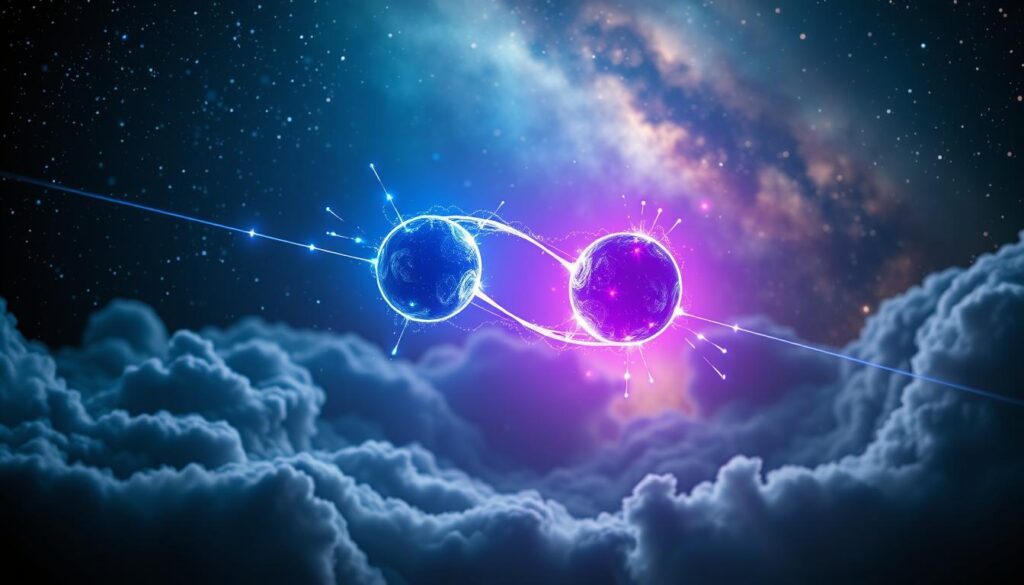
What happened in the latest tests of quantum entanglement
Recent experiments have tested the limits of physics. Researchers measured particle pairs that stayed synchronized across hundreds of kilometers.
How entangled particles produce matching measurements without ordinary communication
These particles do not send signals to coordinate their actions. Instead, they share one state, with their properties undefined until someone measures them. After measurement, both particles instantly settle into matching states, challenging our usual view of space.
Where the experiments took place and which researchers were involved
Teams around the world used advanced systems to test these limits. Their work used precise laboratories and special equipment that shielded particles from environmental noise.
Satellite links, quantum laboratories, and increasingly reliable detector systems
Scientists use orbiting satellites to send entangled photons to ground stations. These increasingly reliable detector systems support longer-distance tests than before. The table shows how these experimental setups have developed:
| Technology | Primary Function | Advantage |
|---|---|---|
| Satellite Links | Long-range transmission | Global coverage |
| Quantum Labs | Particle isolation | High precision |
| Advanced Detectors | Data capture | Reduced error rates |
Why entanglement does not allow faster-than-light messaging
Although these correlations appear instant, quantum entanglement cannot send text or data faster than light. Each measurement has a random result, so it sends no usable information.
What the phenomenon reveals about measurement, information, and quantum reality
This limit protects the main laws of relativity. It suggests that the universe does not communicate in the usual way. Instead, information may be woven into reality in ways scientists are only beginning to understand.
How quantum technologies could benefit from the discovery
Using these connections could transform our digital future. Possible uses include:
- Quantum Computing: Solving complex problems that are currently impossible for standard machines.
- Secure Communication: Creating unhackable networks through quantum key distribution.
- Precision Sensing: Developing sensors with sensitivity far beyond current limits.
The Cosmic Microwave Background Shows the Universe's Ancient Afterglow
Looking back to the dawn of time reveals secrets hidden in plain sight. The cosmic microwave background preserves radiation released roughly 380,000 years after the Big Bang. This faint signal shows the young universe and offers a measurable view of our origins.
Nature works through complex processes that can challenge simple intuition. As astronomers study ancient light, biologists examine cellular energy production. These tiny power plants inside our cells drive life through physical laws, not magic.
The human gut microbiome shows this hidden complexity. Trillions of microorganisms work together to support our health. They show that reality has more layers than it first appears, and deeper investigation can explain what seems impossible.
Evidence-based science links the vast cosmos with our own biology. Readers should keep exploring these frontiers. New discoveries await those who question the world around them.