
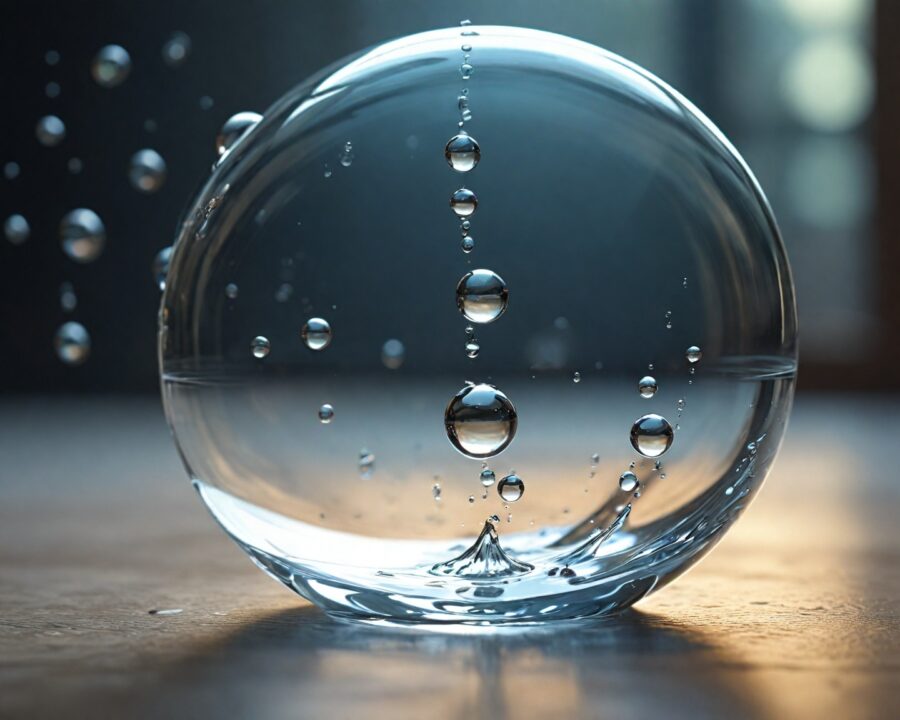
How Surface Tension Works: Examples and Real-Life Applications
Surface tension is a fascinating phenomenon that we encounter in various forms every day, even if we don’t realize it. This invisible force is what makes water droplets bead up on a leaf, allows insects to walk on water, and makes soap bubbles spherical. Understanding surface tension is crucial not only for appreciating these small wonders of nature but also in numerous scientific and industrial applications.
At its core, surface tension is the elastic tendency of a fluid surface to acquire the least surface area possible. This might sound complex, but it essentially means that molecules on the surface of a liquid are more tightly packed, creating a “skin” that can exert significant forces under the right conditions. This article delves deep into the science of surface tension, its implications in nature, technology, and beyond.
What is Surface Tension? An Introduction to the Concept
Surface tension is a measure of the attractive force acting on the molecules at the surface of a liquid. Unlike the molecules in the interior, surface molecules are not surrounded by similar molecules on all sides, leading to cohesive forces that pull them inward.
This effect results in a liquid behaving as if its surface is covered with a stretched elastic membrane. In many liquids, including water, surface tension causes the surface to act as a barrier to foreign objects.
For instance, the classic image of dew drops resting on a spider web or the ability of small insects to walk on water are direct manifestations of surface tension. Understanding this concept is essential in fields ranging from pharmacology to materials science.
The Science Behind Surface Tension: Molecular Forces Explained
To fully grasp surface tension, one must delve into molecular dynamics. Inside a liquid, molecules are pulled equally in all directions by neighboring molecules, creating a stable environment. However, at the surface, these molecules experience a net inward force because there is no liquid above to pull them outward.
The balance of forces results in the minimization of surface area, a behavior best explained through concepts in thermodynamics. The minimization of energy is a central principle, driving surfaces to reduce area and become tense.
On a molecular level, surface tension arises from the cohesive forces between liquid molecules. For example, hydrogen bonds in water create a high surface tension compared to other liquids like alcohol. The strength of these forces varies depending on the liquid and contributes to the variety of surface tension examples observed in different materials.
Everyday Examples of Surface Tension in Action
Surface tension manifests in numerous everyday phenomena, often unnoticed. Here are a few compelling examples:
- Formation of Droplets: Water naturally forms spherical droplets when it rains because a sphere has the minimal surface area for a given volume, minimizing surface tension.
- Floating a Paperclip: With careful placement, a paperclip can be made to float on water due to the surface tension creating a balancing force.
- Soap Bubbles: Bubbles form because surface tension minimizes the air-liquid interface. The addition of soap reduces water’s surface tension, stabilizing the bubble’s shape.
These examples highlight how surface tension is constantly at work around us, maintaining balance and creating unique physical interactions.
How Surface Tension Impacts Nature and Ecosystems
Surface tension plays a critical role in various natural processes and ecosystems. In aquatic environments, it affects how organisms interact with the water surface, influencing feeding, habitat, and even transportation.
The phenomenon allows certain insects, such as water striders, to move across the water surface with ease. This adaption is vital for their survival, aiding in hunting and evading predators.
Moreover, surface tension affects plant life through the process of capillarity. Water is drawn up through capillaries in plants, defying gravity due to the combination of surface tension and cohesion. This transportation method is essential for nutrient distribution in flora.
The Role of Surface Tension in Technology and Innovation
In technology, leveraging surface tension has led to advancements in various fields. Its implications are significant in processes such as inkjet printing, where the formation and controlled movement of droplets depend heavily on adjusting surface tension properties.
Microfluidics, a field focusing on the control of small fluid volumes, exploits surface tension and is crucial for developing medical devices like lab-on-a-chip technologies. Manipulating liquids at this scale enables precise biochemical analysis and diagnostics.
Additionally, surface tension is a key consideration in manufacturing processes such as metal casting and the development of coatings, ensuring efficient material distribution and stability.
Common Questions About Surface Tension Answered
What causes surface tension?
Surface tension is caused by the cohesive forces between liquid molecules. At the surface, molecules have fewer neighbors to bond with, creating a net inward pull that forms a tensioned “skin.”
How does temperature affect surface tension?
Temperature generally decreases surface tension. Heat agitated molecules become less cohesive, reducing their ability to maintain a tight surface layer.
Why do soaps and detergents lower surface tension?
Soaps and detergents contain surfactants that interfere with the cohesive forces between water molecules, reducing surface tension and allowing better spreading and mixing.
Can surface tension be negative?
Surface tension is inherently a positive quantity as it reflects the energy required to increase surface area. Negative surface tension would imply spontaneous surface expansion, which contradicts physical laws.
How is surface tension different in various liquids?
Different liquids exhibit varying surface tensions based on molecular composition. For example, mercury has a high surface tension due to strong metallic bonding, whereas alcohols typically have lower surface tension than water.
Experiments to Demonstrate Surface Tension at Home
Home experiments are a great way to observe surface tension firsthand. Here are a few you can try:
- Floating a Paperclip: Gently placing a paperclip on water can demonstrate how surface tension supports light objects.
- Penny Challenge: Count how many water droplets can fit on a penny before spilling over, showcasing surface tension’s ability to hold the liquid together.
- Milk and Food Coloring: Add drops of food coloring to milk and then a drop of dish soap. Watch how the colors swirl, illustrating how soap lowers surface tension and disrupts uniformity.
The Importance of Surface Tension in Industrial Applications
In industrial contexts, surface tension is a critical factor in processes like coating, painting, and spraying. Ensuring proper adhesion and distribution of liquids in manufacturing requires a careful understanding of surface tension dynamics.
| Industry Process | Role of Surface Tension |
|---|---|
| Painting & Coating | Ensures even spread of paint |
| Detergent Formulation | Enhances cleaning efficiency |
| Metal Casting | Affects mold filling dynamics |
Industries utilize additives to manipulate surface tension, ensuring optimal conditions for their specific applications. This control can lead to increased efficiency, reduced waste, and improved product quality.
How to Measure Surface Tension: Tools and Techniques
Various tools and techniques are used to measure surface tension accurately:
- Capillary Rise Method: Involves observing the height to which liquid rises in a thin tube, relating to surface tension.
- Pendant Drop Method: Measures the shape of a droplet suspended from a syringe to determine surface tension.
- Du Noüy Ring Method: A ring is dipped in the liquid, and the force required to break the film is measured.
These methodologies help scientists and engineers determine surface tension values crucial for research and application development.
Future Research and Advancements in Surface Tension Studies
As science progresses, the study of surface tension continues to evolve. Future research aims to understand the effects of nano-scale interactions and create advanced materials with tunable surface tension for specific applications.
Innovations in biomimetics, drawing inspiration from nature’s sophisticated use of surface tension, promise new technologies that could revolutionize fields ranging from medicine to environmental science.
Continued exploration into this subject will likely lead to breakthroughs that harness surface tension in ways that improve daily life and technological capabilities.
Recap
Surface tension is a fundamental concept with widespread implications across nature, technology, and industry. From allowing insects to walk on water to influencing cutting-edge microfluidics, understanding and manipulating surface tension offers numerous opportunities for innovation and discovery. As research advances, surface tension remains a dynamic field, promising exciting developments in both familiar and emerging applications.