
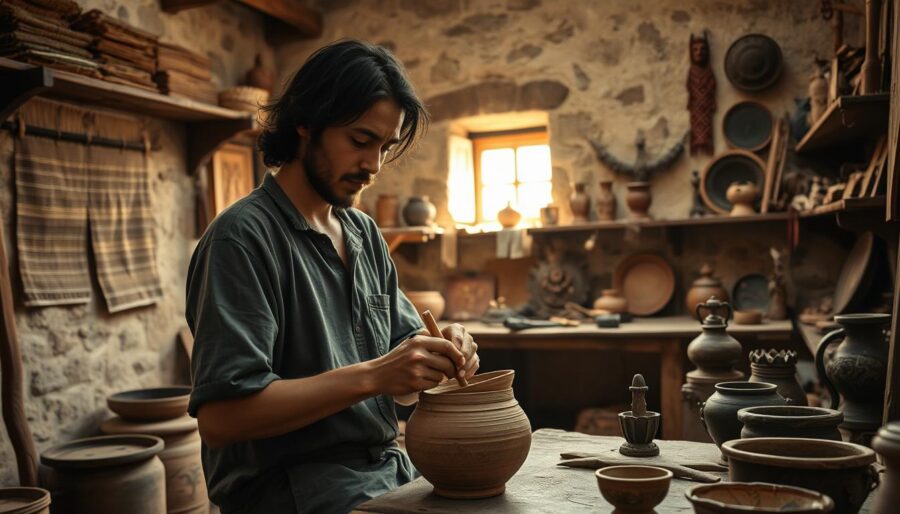
Modern researchers are uncovering secrets behind ancient ingenuity. These lost craftsmanship techniques from historical civilizations show how early societies mastered their environments through bold innovation.
Experts study Roman concrete and Damascus steel to learn why they last so long. They also examine Egyptian faience, Inca stone fitting, and unique textile dyeing methods to learn how people made them.
Each discovery reveals a perfect blend of material science and human skill. Scientists use advanced tools to decode these legacies and show how the past still teaches our modern world.
Key Takeaways
- Researchers are using modern science to decode ancient manufacturing secrets.
- Roman concrete and Damascus steel remain top subjects for material analysis.
- Inca stone fitting demonstrates a high level of precision engineering.
- Ancient textile dyeing shows a deep understanding of natural chemistry.
- These studies bridge the gap between ancient wisdom and current technology.
2. Lost craftsmanship techniques from historical civilizations
New analytical tools are changing how scholars study historical manufacturing processes. They now decode the lost craftsmanship techniques from historical civilizations that helped objects survive for millennia.
Why researchers are revisiting ancient workshop skills now
Modern industry often struggles with sustainability and long-lasting materials. Scientists look back for forgotten solutions to today's engineering challenges. Many ancient materials last longer than modern synthetic alternatives.
This renewed interest comes from the need for stronger building materials. Researchers study ancient mortars and metals to develop more eco-friendly products. This work seeks better ways to build, not just academic knowledge.
What recent excavations and laboratory studies are revealing
Recent fieldwork now examines more than finished goods. Archaeologists carefully record production waste, microscopic residues, and discarded tools at ancient sites. These clues offer a clear window into master artisans' daily work.
Through experimental archaeology, teams recreate ancient processes in controlled settings. They test firing temperatures and raw material mixtures to learn how items were made. This hands-on work shows that ancient makers understood chemistry and physics.
How these discoveries connect archaeology with modern conservation
Preserving cultural heritage connects the past with the present. When experts understand how a monument or artwork was made, they can perform more accurate repairs. This keeps historical sites intact for future generations to study and enjoy.
Furthermore, experimental archaeology helps validate historical texts. When an experiment matches an ancient manuscript's description, it supports that record's accuracy. The lost craftsmanship techniques from historical civilizations are real skills that people can recover and respect.
Roman Concrete Composition and the Structures That Still Endure
Roman builders built structures that have faced crashing waves for two thousand years. Modern concrete often crumbles within decades, but the Roman concrete composition remains intact along many coasts. These harbors and breakwaters show engineering that valued lasting strength over fast construction.
Where Roman marine concrete has survived for centuries
Many of these lasting structures stand along the Mediterranean coastline. Cosa's ancient harbor in Italy has massive concrete piers that resisted seawater erosion for over 2,000 years. These sites give scientists a rare laboratory for studying how durable materials face harsh marine conditions over geological timescales.
Volcanic ash, lime, seawater, and self-healing mineral growth
This strength comes from a specific chemical reaction between volcanic ash and lime. When mixed with seawater, these materials trigger a process called the pozzolanic reaction. The reaction creates tobermorite, a rare mineral that grows stronger over time.
As seawater filters through the concrete, it dissolves parts of the volcanic ash. This process encourages new mineral crystals to fill cracks and voids. This self-healing mechanism seals the structure and prevents decay inside modern steel-reinforced concrete.
Researchers and engineers testing Roman formulas today
Scientists now work to copy these ancient mixtures for stronger modern infrastructure. By studying the ratios used by Roman architects, they hope to create more sustainable building materials. This research could reduce the global construction industry's carbon footprint.
How archaeological residue analysis identifies ancient ingredients
Experts use archaeological residue analysis to understand these formulas. The method examines microscopic samples from ancient sites. Chemical signatures from the original ingredients help researchers separate the first construction from later repairs.
Why modern replicas do not always reproduce Roman performance
Modern replicas often fail because their raw materials and curing conditions differ. Roman builders used volcanic deposits that modern supply chains may not provide. Also, antiquity's slow, natural curing process is hard to scale for today's fast construction demands.
| Feature | Roman Concrete | Modern Concrete |
|---|---|---|
| Primary Binder | Volcanic Ash & Lime | Portland Cement |
| Durability | Increases over time | Decreases over time |
| Environmental Impact | Low carbon footprint | High carbon footprint |
| Maintenance | Self-healing properties | Requires frequent repair |
Damascus Steel Forging and the Mystery of Its Distinctive Blades
Few past artifacts hold as much mystery as the shimmering, water-like patterns on historical swords. These iconic weapons were prized for their exceptional sharpness and durability in battle. Today, historians and metalworkers remain fascinated by this legendary Damascus steel forging.
How crucible steel production shaped Damascus blades
The secret lay in crucible steel, made by melting iron with carbon-rich additives. Artisans sealed these materials in clay crucibles and heated them to extreme temperatures. This controlled setting let the metal absorb carbon, creating a structure that was hard yet flexible.
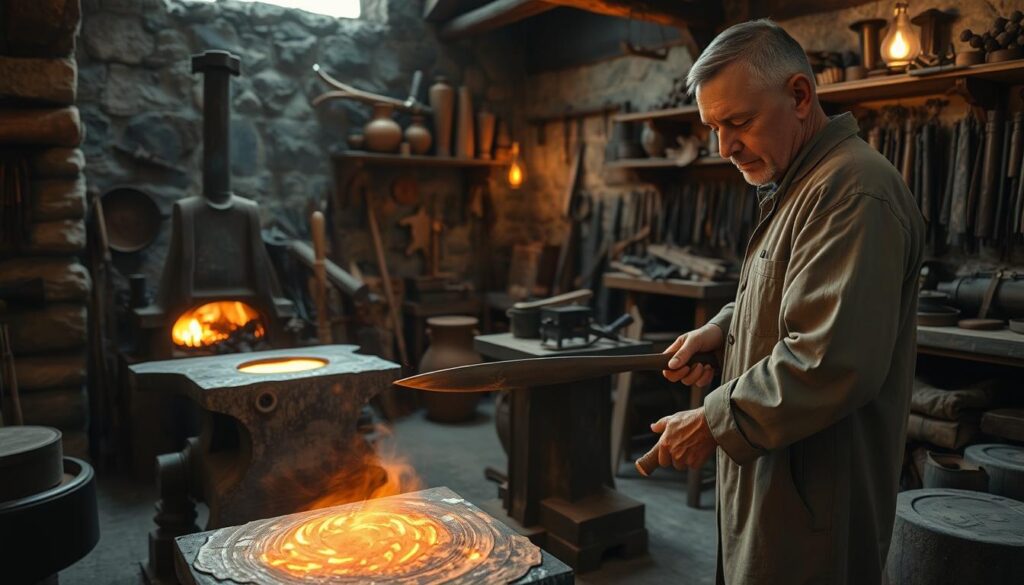
Carbon-rich materials, controlled heating, and patterned surfaces
These surface patterns were not merely decorative; they came from the internal crystalline structure. Smiths controlled cooling to form carbide bands within the steel. After a mild acid etch, the bands appeared as flowing designs that define the craft.
What metallurgical studies say about the loss of the original process
Modern science has struggled to recreate the exact conditions used by ancient masters. Studies show that the original ore often held trace elements, such as vanadium, crucial to the final result. As these raw material sources ran out or were forgotten, authentic production gradually faded.
Experimental archaeology attempts to recreate the forging sequence
Researchers use experimental archaeology to test theories and bridge this gap. By rebuilding ancient furnaces with period-accurate tools, they simulate the complex heating cycles needed for success. These projects provide valuable insights into how ancient smiths balanced temperature and timing to achieve high-quality results.
Why surviving blades cannot provide every manufacturing detail
Existing artifacts alone create major challenges for modern investigators. Corrosion, repeated sharpening, and historical repairs have often hidden the original surface features. Without written records, experimental archaeology must fill gaps in incomplete historical data.
Regional variations also prevent one blade from serving as a complete blueprint for the tradition.
Egyptian Faience Glazing and the Chemistry of Brilliant Color
Exploring faience production shows how ancient craftsmen turned simple quartz into lasting art. Often mistaken for ceramic, it is actually a sintered-quartz ceramic with a unique glow. It remains a fascinating example of early material science.
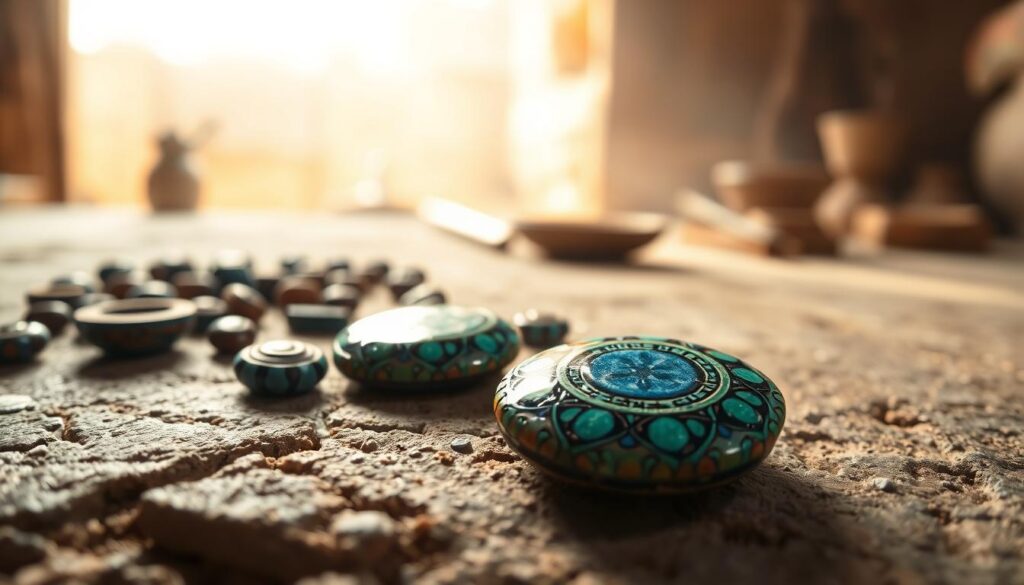
Crafting vibrant blue and green objects
Artisans made these famous shades by balancing mineral ingredients. They mixed crushed quartz or sand with alkaline salts to form each object's body. Then they added copper compounds, which reacted during firing and produced deep blues and greens.
Artisans controlled firing conditions closely so the glaze matured correctly. Precision was essential, because small temperature changes could ruin the chemical reaction. This method supported mass production of small, decorative items valued across the ancient world.
Insights from beads, amulets, and workshop remains
Archaeologists have found much evidence in ancient workshops about these production methods. Excavations often reveal:
- Thousands of small, uniform beads used for jewelry.
- Intricately molded amulets representing protective deities.
- Wall tiles that once decorated royal palaces and temples.
- Kiln fragments containing traces of the original firing materials.
How residue analysis distinguishes surface glazing from self-glazing
Modern researchers use archaeological residue analysis to learn how these surfaces formed. This technique shows whether artisans applied glaze as separate paste or created it through self-glazing. During self-glazing, salts move to the surface during firing and create a natural, glass-like skin.
By examining the outer layer's chemical makeup, scientists can identify the artisan's techniques. This archaeological residue analysis reveals technical choices made thousands of years ago. It confirms that these craftsmen mastered their environment.
What modern museum conservation has learned from ancient recipes
Today, museum conservators use these ancient recipes to preserve fragile artifacts. Understanding the original composition of Egyptian faience glazing helps stabilize objects with surface loss or porosity. By copying these historical mixtures, experts can treat decay and support long-term stability for future generations.
The study of ancient materials is not just about the past; it is about understanding the limits of human ingenuity and the chemistry of our ancestors.
Inca Stone Fitting and the Engineering Behind Seamless Walls
Cusco streets reveal the precision of Inca stone fitting. These huge structures used no mortar, yet they survived for centuries in one of Earth's most active seismic regions.
Where precisely fitted Inca masonry can still be seen
The most iconic examples stand in the former Inca Empire's heart. Visitors gather at the fortress of Sacsayhuamán, where huge boulders lock together so tightly that no blade can pass between them.
Colonial buildings in Cusco also rest on similar foundations. These walls show that builders valued strength and beauty in their city planning.
Stone selection, repeated abrasion, and incremental shaping
Making these seamless joints took great patience and special tools. Artisans chose stones by density and grain, often selecting durable granite or andesite.
They created each precise joint through repeated abrasion, rubbing stones together and chipping their edges with smaller tools. This process made every surface match its neighbor.
How earthquake resistance influenced construction choices
Avoiding mortar was a deliberate engineering choice. Slight movement during earthquakes helped the walls absorb energy instead of cracking under pressure.
"The genius of the Inca lies in their ability to create structures that move with the earth, rather than fighting against it."
This flexible design kept temples and homes standing after other rigid structures collapsed. The table below compares traditional masonry with this ancient technique.
| Feature | Traditional Masonry | Inca Stone Fitting |
|---|---|---|
| Binding Agent | Mortar or Cement | None (Dry-fit) |
| Seismic Response | Rigid/Prone to cracking | Flexible/Energy absorbing |
| Surface Finish | Uniform/Flat | Irregular/Interlocking |
Digital scanning reveals contact patterns between neighboring stones
Modern researchers use digital scanning to map the stones' complex contact points. The scans show that inner surfaces often received as much care as visible exteriors.
This detail shows that builders understood load distribution. Each block helped support the entire wall through a sophisticated system of friction and gravity.
Why the technique involved organized labor as well as individual skill
Individual stonemasons showed great skill, but these huge projects also needed organized labor. Moving, shaping, and placing thousands of tons of rock suggests a highly structured society.
This blend of individual art and shared effort remains a hallmark of their civilization. It shows that great engineering often requires vision and disciplined teamwork.
Ancient Textile Dyeing and the Knowledge Carried Through Cloth
Beyond a garment's weave, ancient textile dyeing reveals a complex history that shaped early civilizations. Colors marked social status, religious identity, and regional pride. These remains show that artisans understood advanced chemistry thousands of years ago.
Indigo, madder, cochineal, and other historically important colorants
Nature gave early dyers many pigments from plants and insects. Indigo, made from leaves of certain shrubs, created deep blue shades that stayed stable for centuries. madder roots made rich reds, while crushed cochineal insects produced prized crimson dyes for global trade.
How fibers, mordants, water quality, and timing affected the final color
Making the right shade required more than raw pigment. Artisans balanced the fiber type, such as wool or linen, with chemical agents called mordants. These metallic salts helped bind dye to fabric, so the color would not wash away.
Water quality also shaped the final color. Minerals in local water could change soft pink to deep purple, while soak time and dye-bath temperature controlled color intensity.
| Dye Source | Primary Color | Origin/Region | Mordant Used |
|---|---|---|---|
| Indigo | Blue | Global/Tropical | Fermentation |
| Madder | Red | Eurasia | Alum |
| Cochineal | Crimson | Americas | Tin/Alum |
| Woad | Blue | Europe | Fermentation |
Textile fragments reveal trade networks and specialized craft communities
Finding specific dyes where their source plants did not grow proves that wide trade networks existed. Specialized craft communities guarded these complex methods and passed them down through generations. These groups were the technological hubs of their time, supplying valuable textiles to elite markets across vast distances.
How chemical testing identifies dyes in fragile archaeological fabrics
Modern science can identify ancient pigments even after their colors fade. Through high-performance liquid chromatography, scientists isolate chemical signatures from specific dyes in one thread. This process reveals ancient textile dyeing methods used by long-lost cultures without harming fragile artifacts.
Why craft knowledge transmission was vulnerable to social disruption
Despite their brilliance, these traditions were fragile. The craft knowledge transmission depended on oral traditions and apprenticeships, which required stability. War, famine, or economic collapse displaced communities and often erased their knowledge of dye chemistry.
This weakness shows how easily human innovation can vanish when social structures fail. Without written manuals, losing one generation of masters could end a unique cultural legacy. Today, we reconstruct these lost techniques to understand our ancestors' ingenuity.
Conclusion
Roman concrete and Inca masonry were complex systems, not simple tricks. They depended on deep knowledge of raw materials, precise timing, and skilled workers. Researchers now see these achievements as models for sustainable engineering and material science.
Effective craft knowledge transmission links past ingenuity with future discovery. By studying these artifacts, experts learn how societies solved structural problems without modern machinery. This work shows how cultural heritage can shape building practices today.
Museums and laboratories guide this continuing research. They protect physical evidence that helps scholars decode lost methods. Successful craft knowledge transmission keeps ancient lessons available to engineers and historians.
Modern research need not copy every historical detail to remain useful. Scientists can draw out core principles to improve current conservation efforts. Readers can visit local museum collections and see these techniques influencing the world today.